


At 3 a.m., you wake up with an intolerable pain in your big toe, and it is red, hot and swollen. Even the light touch of your blanket against it feels unbearable. You already know this pain: another gout flare. You take your medicine and wait for the pain to ease. Once it does, you just go back to your normal daily life, trying hard to forget the night.
What you probably do not do next is check your blood sugar. And yes, that’s very likely because most people with gout never wonder whether the condition has anything to do with their blood glucose level, but the research says it does. In fact, a 2023 systematic review estimated that diabetes affected 19.1% of people with hyperuricemia (high uric acid) and 16.7% of people with gout. [1]
You may be wondering how come two different conditions are associated with each other. Let’s answer all of your questions one by one.
Is Gout Linked to Diabetes?
Yes, but not in the simple cause and effect relationship you may think.
Gout is a form of inflammatory arthritis. It develops when monosodium urate crystals form and deposit in a joint and trigger sudden pain, swelling and redness. Hyperuricemia means having a high level of uric acid in your blood. But having hyperuricemia does not confirm a gout diagnosis. In fact, many people with the condition never develop gout, as crystal formation depends on genetics, kidney function and other factors. So, a single high or normal uric acid reading does not rule either condition in or out.
A 2026 meta-analysis of 87 studies and roughly 978,000 people with type 2 diabetes found hyperuricemia in 22.0% of them and gout in 6.0%, substantially higher than in the general population, though the estimates varied widely across studies and regions.[2]
Type 2 diabetes is a different condition altogether. It develops when the body becomes resistant to insulin and, over time, cannot make enough insulin to keep blood glucose within a healthy range.
Both gout and diabetes are associated because they often share the same underlying risk factors, including insulin resistance, excess body fat, high blood pressure, abnormal blood cholesterol levels and reduced kidney function.[3,4] However, one condition doesn’t trigger the other.
Still, when you’re diagnosed with one condition, your physician may ask you to undergo appropriate testing to rule out the other.
How Are Uric Acid and Diabetes Connected?
Insulin resistance can push uric acid higher
Insulin helps glucose move from your blood into your cells. With insulin resistance, your muscle, fat and liver cells do not respond to it as well as they should. Your pancreas may compensate by releasing more insulin.
In contrast, uric acid is a waste product that your body produces when it breaks down purines, natural compounds found in your own cells and in foods like red meat, organ meat and certain seafood.
Although type 2 diabetes develops through distinct mechanisms, it shares several underlying physiological pathways with gout. When your cells start resisting insulin, the extra insulin produced by your pancreas then signals your kidneys to hold onto uric acid instead of clearing it. As a result, the serum urate level rises.
A large genetic study found that insulin resistance led to a higher serum uric acid level, but not the other way around. Lowering insulin levels could reduce serum urate levels and gout risk, but reducing serum urate levels had little effect on insulin resistance.[3] In addition, a meta-analysis of four trials involving 314 patients found that urate-lowering treatment with allopurinol reduced fasting glucose levels in people without diabetes but not in those with diabetes. It also did not significantly improve HbA1c.[4]
Metabolic syndrome is where the paths often cross
Metabolic syndrome may sound like a single disease but is a group of related conditions. These include obesity, hypertension (high blood pressure), increased serum triglycerides, abnormal cholesterol levels and high blood sugar. Having several of these together raises the risk of type 2 diabetes and cardiovascular disease.
Uric acid often rises alongside these conditions but is not one of the criteria used to diagnose metabolic syndrome. However, because reduced kidney clearance of uric acid is a well-recognized feature of it, many endocrinologists treat a high serum urate reading as an early sign worth watching.[5]
The two numbers do not always move together
Uric acid and blood glucose are related, but you cannot reliably predict one from the other.
In fact, uric acid levels can behave unexpectedly in people with diabetes. When blood glucose rises high enough to spill into the urine, the kidneys may excrete more urate at the same time. As a result, serum urate levels may fall even if blood glucose continues to rise.[6]
A normal uric acid test result does not mean that your blood sugar is also normal. Likewise, one high glucose reading does not explain a gout flare. Each test provides different information.
So, a high uric acid result may be a good reason to discuss your diabetes risk with your clinician, although it does not mean that you will develop diabetes. Lowering uric acid remains important for managing gout, but it should not be expected to prevent diabetes on its own.
Should You Test Both Uric Acid and Blood Glucose?
There is no rule that everyone with gout needs to monitor blood glucose, or that everyone with diabetes needs to test uric acid. Testing both is more likely to be useful for three groups.
The first group includes people with gout who also have a recognized risk factor for diabetes, such as excess weight, a family history of diabetes or high blood pressure. The second is people with hyperuricemia, especially when other markers of metabolic syndrome are also present. The third includes people with prediabetes or diabetes who develop joint pain or swelling consistent with gout. Unusual thirst, frequent urination, unexplained fatigue or blurred vision are also reasons to ask your clinician about diabetes testing.
What Do Uric Acid and Blood Sugar Tests Actually Tell You?
A home meter can help you track changes in blood glucose or uric acid levels, but it cannot diagnose gout, prediabetes or diabetes. Glucose readings taken before or after meals may show how food, physical activity, illness or medication affects your blood sugar at specific times. Repeated uric acid readings may show whether your serum urate level is approaching the target set by your physician. Your physician can then compare these home readings with laboratory results, such as fasting plasma glucose, HbA1c, serum urate and kidney function tests.
Diagnosing diabetes requires laboratory blood tests interpreted by a physician or another qualified healthcare professional.[7] Gout also cannot be diagnosed from a uric acid reading alone. Diagnosis requires a thorough evaluation of your symptoms and examination findings, sometimes supported by joint-fluid analysis or imaging.

How to Monitor Both Uric Acid and Blood Glucose at Home
Test while fasting when possible. Do not eat for at least eight hours before either test; drinking water is fine. A fasting blood glucose level of 100–125 mg/dL (5.6–6.9 mmol/L) suggests prediabetes, while a level of 126 mg/dL (7.0 mmol/L) or higher suggests diabetes. For more information about what these numbers mean in daily life, see our guide to understanding your blood sugar readings.
Know your target ranges. For people without diabetes, most physicians consider a fasting blood glucose level of 99 mg/dL (5.5 mmol/L) or lower to be within the normal range. If you take urate-lowering medication, the typical serum urate target is below 6 mg/dL (360 µmol/L).[8]
Retest after a flare. Serum urate levels can temporarily fall during a gout flare, so a reading taken during a flare may appear falsely normal. If your result is lower than 6 mg/dL but gout is still strongly suspected, NICE recommends repeating the test at least two weeks after the flare has settled.[9] For general flare prevention, see our gout management tips.
Use the correct strip and setting. A dual-function meter uses separate strips for glucose and uric acid. Follow the device manual for each test.
Wash and dry your hands. Food residue or moisture can affect a fingerstick result. Use a new lancet and an unexpired strip each time. Our guide on why two fingersticks give different readings explains how testing technique can change the number.
Check the test conditions. Heat, cold and humidity can affect test strips and meters. Use them within the operating range stated in the manual.
Record context, not just readings. Note the date, time, meals, gout symptoms, medicines and any instructions from your physician. Patterns are usually more useful than an isolated result.
Frequently Asked Questions (FAQs)
Can gout raise blood sugar?
A gout flare can temporarily raise your blood sugar level due to pain, inflammation, poor sleep and physical stress. Corticosteroids sometimes used to treat flares can also raise blood glucose for a short while.[10] However, gout does not raise your diabetes risk on its own. Ask your physician or pharmacist whether additional tests are needed.
Can diabetes cause high uric acid?
Insulin resistance can reduce the kidneys’ ability to remove urate, which may raise serum uric acid levels. However, conditions like glycosuria (glucose in the urine) may lower uric acid levels by increasing the excretion of both glucose and urate in the urine.[3,6]
Does lowering uric acid reduce diabetes risk?
Current evidence does not support that urate-lowering treatment prevents diabetes.[4] Keep taking gout medicine as prescribed, but manage diabetes risk separately with your physician.
How often should I test both?
There is no universal testing schedule. How often you should test depends on your individual risk factors, gout activity, diabetes risk, treatment plan and kidney function. Your physician can recommend a schedule that is appropriate for you.
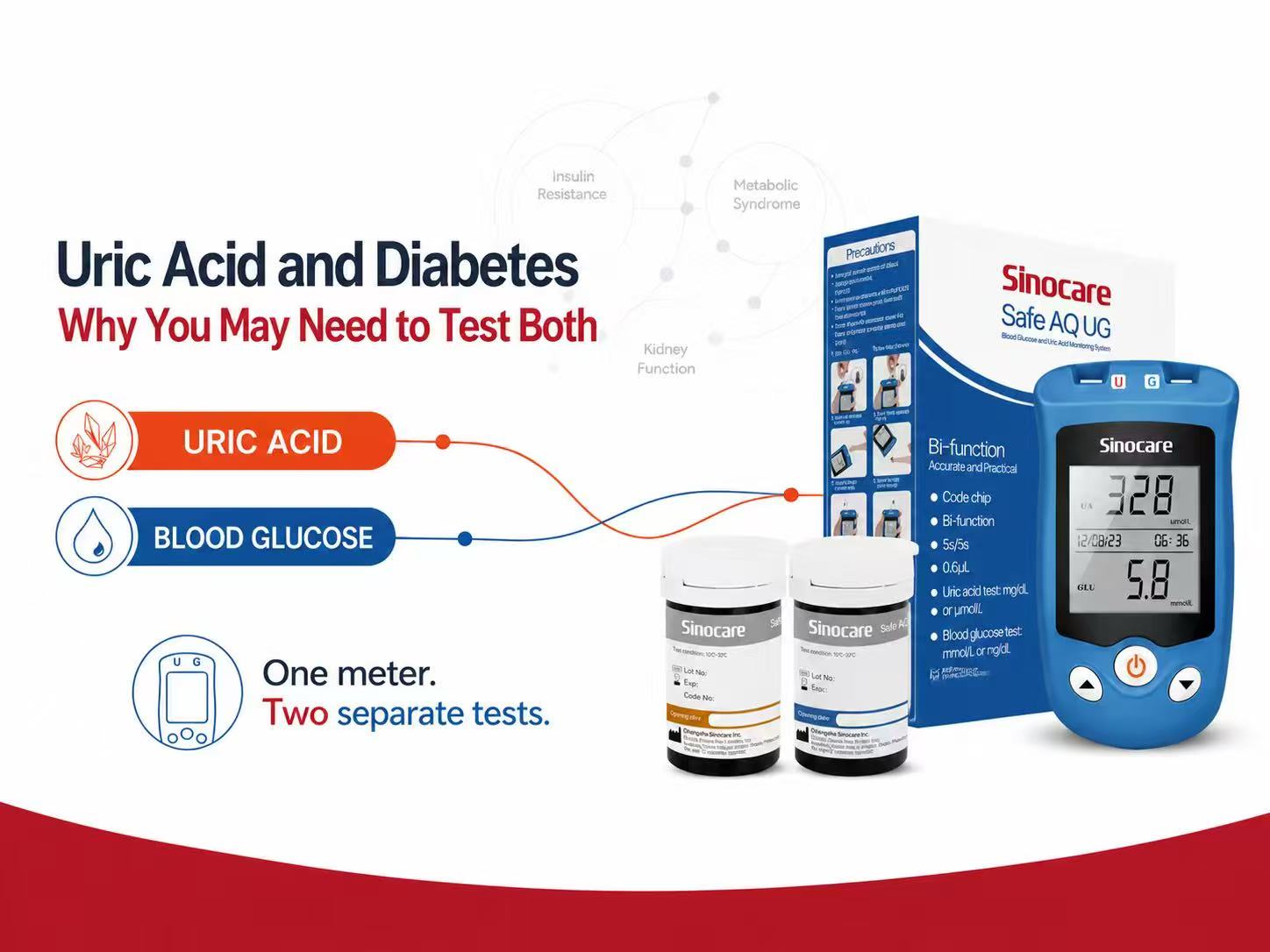
Monitor Uric Acid and Blood Glucose with One Meter
If your physician recommends monitoring both blood glucose and uric acid, you may consider the Sinocare Safe AQ UG. This single machine with double-slot design can run both tests, although each test requires separate strips and blood samples.
The glucose test uses 0.6 µL of blood and takes about five seconds. The uric acid test uses 3 µL and takes about 25 seconds. The meter can store up to 100 results for each type of test.
The Sinocare Safe AQ UG is available in most countries worldwide, excluding the United States. If the meter fits the testing schedule and target ranges recommended by your physician, you can buy it through the Sinocare Safe AQ UG product page.
References
1. Jiang J, Zhang T, Liu Y, et al. Prevalence of diabetes in patients with hyperuricemia and gout: a systematic review and meta-analysis. Curr Diab Rep. 2023;23(6):103-117. doi:10.1007/s11892-023-01506-2
2. Gao L, Ye G, Liu C, et al. Prevalence and risk factors of hyperuricemia and gout in patients with type 2 diabetes mellitus: a systematic review and meta-analysis. Front Endocrinol (Lausanne). 2026;17:1857217. doi:10.3389/fendo.2026.1857217
3. McCormick N, O'Connor MJ, Yokose C, et al. Assessing the causal relationships between insulin resistance and hyperuricemia and gout using bidirectional Mendelian randomization. Arthritis Rheumatol. 2021;73(11):2096-2104. doi:10.1002/art.41779
4. Chen J, Ge J, Zha M, et al. Effects of uric acid-lowering treatment on glycemia: a systematic review and meta-analysis. Front Endocrinol (Lausanne). 2020;11:577. doi:10.3389/fendo.2020.00577
5. Raya-Cano E, Vaquero-Abellán M, Molina-Luque R, et al. Association between metabolic syndrome and uric acid: a systematic review and meta-analysis. Sci Rep. 2022;12(1):18412. doi:10.1038/s41598-022-22025-2
6. Kuwabara M, Fukuuchi T, Aoki Y, et al. Exploring the multifaceted nexus of uric acid and health: a review of recent studies on diverse diseases. Biomolecules. 2023;13(10):1519. doi:10.3390/biom13101519
7. National Institute of Diabetes and Digestive and Kidney Diseases. Diabetes tests & diagnosis. Last reviewed July 2022. Accessed July 18, 2026. https://www.niddk.nih.gov/health-information/diabetes/overview/tests-diagnosis
8. FitzGerald JD, Dalbeth N, Mikuls T, et al. 2020 American College of Rheumatology guideline for the management of gout. Arthritis Care Res (Hoboken). 2020;72(6):744-760. doi:10.1002/acr.24180
9. National Institute for Health and Care Excellence. Gout: diagnosis and management. NICE guideline NG219. Published June 9, 2022. Accessed July 18, 2026. https://www.nice.org.uk/guidance/ng219/chapter/Recommendations
10. Cho JH, Suh S. Glucocorticoid-induced hyperglycemia: a neglected problem. Endocrinol Metab (Seoul). 2024;39(2):222-238. doi:10.3803/EnM.2024.1951


Leave a comment
All comments are moderated before being published.
This site is protected by hCaptcha and the hCaptcha Privacy Policy and Terms of Service apply.