


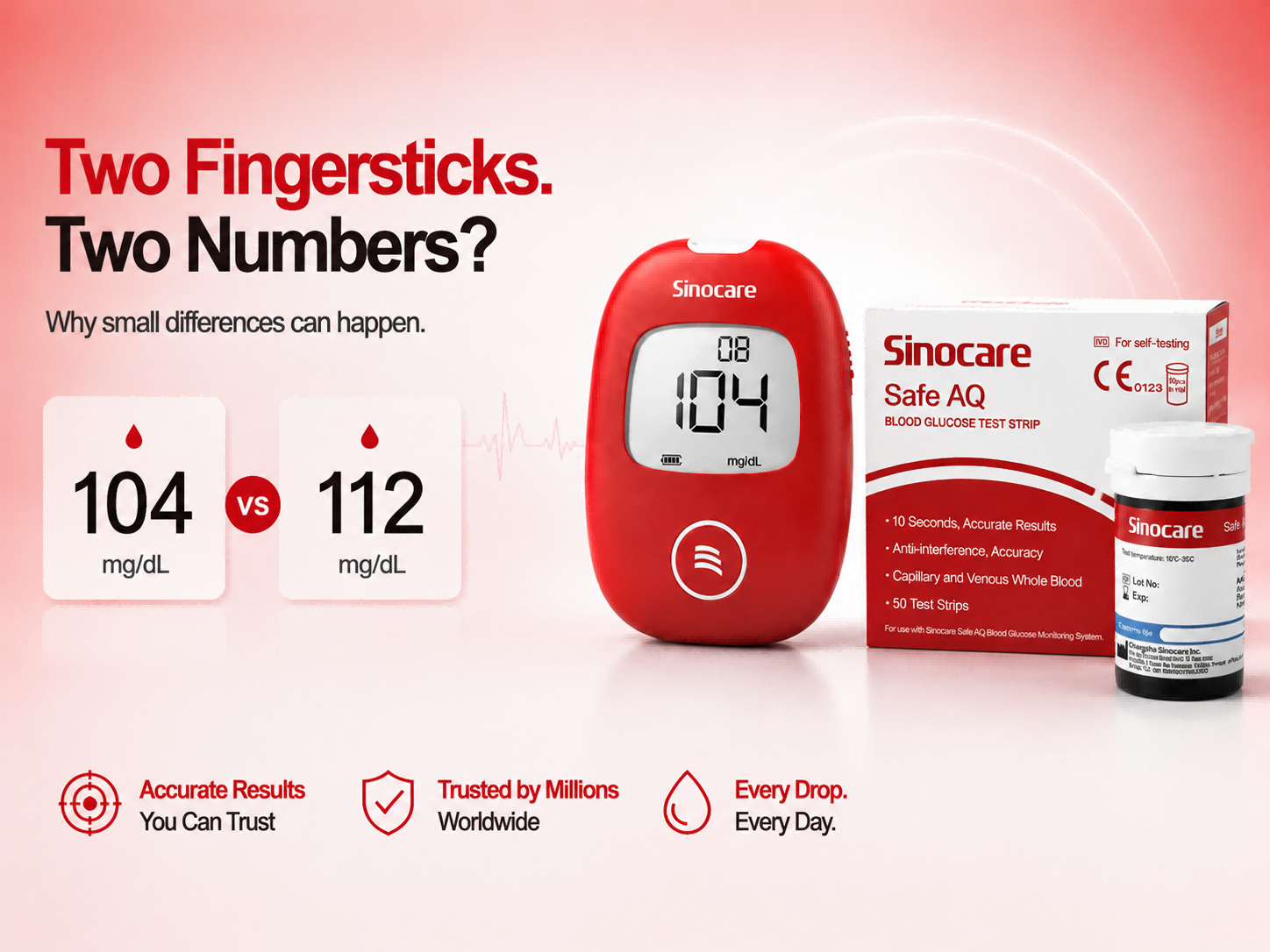
When you prick your finger twice in a row and see two different blood sugar readings on your glucose meter, it’s easy to have some doubts or confusion about the result. Is my meter okay? Is this normal? Should I wash my hands and check again? But no worries, small differences in back‑to‑back finger‑stick readings are totally normal. In fact, this will happen to almost everyone who uses a blood glucometer.
Let us explain why two readings can differ, how much difference is okay and what you can do to get the most reliable results.
Is My Meter Broken?
No, that’s highly unlikely! Getting two different back-to-back readings does not mean there is a defect in your meter. If the difference is small, there is nothing to worry about, and you can consider the result expected. In fact, such a difference usually happens due to a variety of reasons. We have covered those reasons in the infographic below.
So the simple rule is that a small difference in back-to-back readings is perfectly normal, but a large difference is not. When you are unsure, retest once with good technique, and look at the result alongside your symptoms rather than chasing one perfect number.
Understanding Accuracy Versus Repeatability
There are two relevant terms related to blood glucometers that may sound similar when you hear them, but they actually mean two different things. These include accuracy and precision.
Accuracy is how close your reading is to an actual laboratory result. Blood sugar meters are designed to generate readings within a range, not to give the same readings every time. International standards such as ISO 15197:2013 require that at least 95 % of results must fall within ±0.83 mmol/L (±15 mg/dL) when true glucose levels are < 5.55 mmol/L (100 mg/dL) and within ±15 % when glucose is ≥ 5.55 mmol/L.[1] U.S. Food and Drug Administration (FDA) guidance similarly expects 95 % of results within ±15 % and 99 % within ±20 % of a reference method.[2] This simply means a reading of 150 mg/dL and a repeat reading of 165 mg/dL can both be accurate, because they fall within the allowable ±15% range.
Precision (also called repeatability) is how similar two readings are to each other when you test the same sample. But this does not mean your two fingerstick results must match within 15% of each other. In fact, each can meet accuracy criteria even if they differ by more than 15% from each other. This is because each reading carries its own small margin. For example, if your actual blood sugar is 150 mg/dL, one fingerstick reading could be 138 mg/dL and another 164 mg/dL; both would still be within ±15 % of the true value. So, a 10–15 % difference between two readings is usually not a sign of a faulty meter. [3]
Why Two Fingerstick Readings Differ
There are several causes that can affect blood glucose reading. Use the infographic below to understand what affects your glucometer’s readings and when to retest.

How to Get Consistent Blood Sugar Readings
The following steps can minimize differences in two fingerstick readings:
- Wash and dry your hands thoroughly. Your fingers may have trace amounts of food residue or other substances on them, which can affect the reading.
- Use the sides of your fingertip or palm as these areas have fewer nerve endings and are recommended by the ADA. [4]
- Use a fresh lancet and strip. Lancets dull quickly and strips expire. Always prefer using a fresh strip from a tightly capped vial.
- Do not squeeze the finger; use a full, free-flowing drop. Over‑squeezing introduces tissue fluid and can lower the reading.
- Use a drop large enough to fill the strip in one go. A short fill is a common cause of odd numbers.
When to Retest or Seek Help
Most differences between consecutive fingerstick readings are usually clinically insignificant, but a few are not and warrant immediate attention:
- Blood glucose reading isn’t matching symptoms. If you feel symptoms of hypoglycemia (shaking, sweating, confusion) but the meter shows a high number, retest immediately. Similarly, if your meter reads low but you feel absolutely fine, repeat the test.
- Repeated readings either below 70 mg/dL (3.9 mmol/L) or above 250 mg/dL (13.9 mmol/L). After two back-to-back abnormal results, retest with another device and contact your GP.
- Repeated large differences. If two or more test results differ by more than 25%, and you have ruled out user error, check the meter with a control solution. If the meter fails, replace it or contact the manufacturer.
Frequently Asked Questions (FAQ)
Why are my blood sugar readings different within seconds?
Two readings can actually differ. In fact, a small difference is expected. This is because each drop of blood has slightly different glucose and the meter’s sensors have built-in variability. Differences of about 10–15% are generally normal.
Should I use the first or second drop?
If your hands are clean and fully dry, the first drop is fine. But if they are not, wipe off the first drop and use the second. [5, 6]
Which finger is best?
Use the sides of your fingertips because they have fewer nerve endings. Rotate sites to avoid soreness and calluses. Alternative sites (palm, forearm) can be used when glucose is stable but are less reliable during rapid changes. [7]
How do I know if my meter is accurate?
Many modern meters are factory-calibrated. Follow the manufacturer’s instructions. Run a control solution test to check if the reading is within the mentioned range. Choosing a meter that meets the ISO 15197 standard also helps keep readings reliable.[1]
Do I need to retest if the readings differ by 15%?
Not necessarily. If your blood sugar reading matches how you feel, you don’t need to do any retest. But if it doesn’t match symptoms, wash your hands, use a new strip and test again. Call your GP if you remain unsure.
Why Choosing a Reliable Meter Matters?
A reliable meter gives you peace of mind by providing consistently high-quality blood sugar readings without having to worry about inconsistent results.
Sinocare, founded in 2002 in Changsha, China, ranks No. 1 in China and No. 4 worldwide in blood glucose monitoring and serves more than 25 million users across 135 countries and regions. Its meters use code-free, FAD-GDH test strips that need only a tiny drop of blood, which lowers the chance of a short fill.
Sinocare Safe AQ Smart
The Safe AQ Smart is a compact, no‑coding glucose meter that delivers results in five seconds. It requires a small blood volume and has a large display.
Sinocare Safe AQ Pro I
The Safe AQ pro I offers a larger memory and multiple measurement units. It uses five‑electrode strips to improve stability and has a ketone‑warning indicator to help detect high ketone levels. Results appear in five seconds without coding.
These meters meet current ISO accuracy standards and come with clear instructions. By combining good testing technique with a reliable device, you can reduce the chance of getting readings outside the allowable ±15% range.
References
1. International Organization for Standardization. ISO 15197:2013. In Vitro Diagnostic Test Systems—Requirements for Blood Glucose Monitoring Systems for Self-Testing in Managing Diabetes Mellitus. ISO; 2013.
2. US Food and Drug Administration. Blood glucose monitoring devices. FDA; updated 2024. Accessed June 8, 2026.
3. Evaluation of the accuracy, precision, and agreement of a glucometer compared to the standard laboratory test in diabetic and non-diabetic patients. Sci Rep. 2025;15. doi:10.1038/s41598-025-28009-2.
4. ElSayed NA, McCoy RG, Aleppo G, et al. Diabetes technology: standards of care in diabetes—2025. Diabetes Care. 2025;48(suppl 1).
5. Mathew TK, Zubair M, Tadi P. Blood glucose monitoring. In: StatPearls. StatPearls Publishing; updated 2025.
6. Dong X, Zhang C, Wu T, Zhu B. First versus second drop of capillary blood for monitoring blood glucose: a meta-analysis and systematic review. Arch Med Sci. 2024;20(6):1909-1917. doi:10.5114/aoms/186657.
7. Anitha Pavithran A, Ramamoorthy L, Bs S, Murugesan R, Mj K. Comparison of fingertip vs palm site sampling on pain perception, and variation in capillary blood glucose level among patients with diabetes mellitus. J Caring Sci. 2020;9(4):182-187. doi:10.34172/jcs.2020.028.


Leave a comment
All comments are moderated before being published.
This site is protected by hCaptcha and the hCaptcha Privacy Policy and Terms of Service apply.