


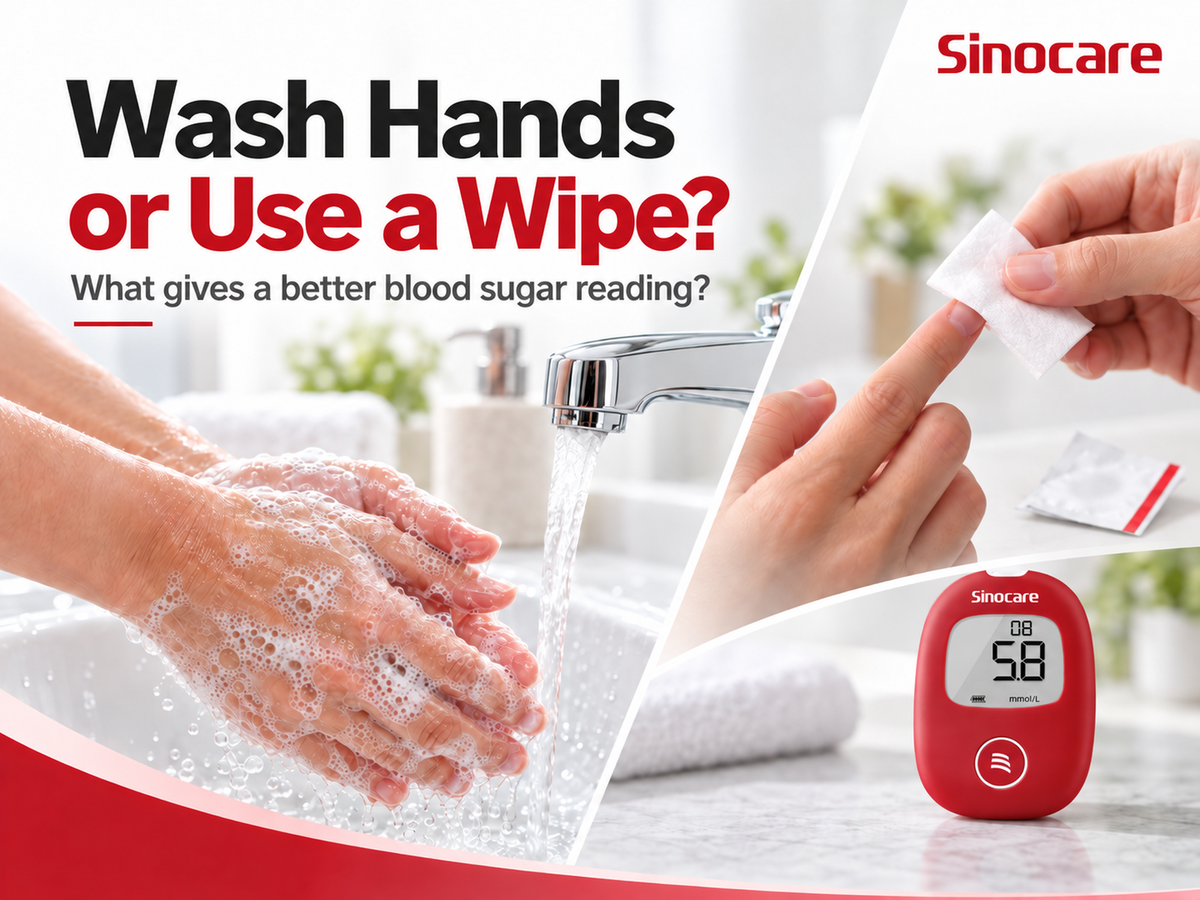
Wash your hands with soap and water, then dry them thoroughly before a routine blood sugar test at home.[1] This washes away food residue that could mix with the blood sample and change the reading. Disinfecting the skin with alcohol has its own benefits, but it is unlikely to remove food residue from the skin’s surface.[2, 3]
But you may wonder: I’ve seen nurses at my local hospital use an alcohol wipe before drawing blood. Why is the advice different at home? Isn’t alcohol enough? The answer depends on what you’re trying to remove and how the blood sample is collected.

Why should you wash your hands before testing?
You peel an orange, eat a few pieces and then get your meter out. Your fingers may look clean, but traces of juice can remain on the skin. When you prick your finger, glucose from the fruit can enter the blood drop. The meter then measures a contaminated sample, which can make the result falsely high.[2, 3]
This is different from the rise in blood sugar that you usually see after having a meal, when glucose from digested foods enters your bloodstream. But if food residue is left on your hand, it is likely that a trace amount of sugar may mix with the collected blood sample.
A small study tested this by having 10 volunteers handle fruit before checking their blood sugar. Alcohol wiping did not reliably prevent falsely high readings, even when the fingers were wiped repeatedly. Washing with tap water prevented those elevations in the experiment.[2]
A separate study in 123 adults with insulin-treated diabetes found the same practical problem: fruit residue could produce falsely high readings, and washing with soap and water brought most readings closer to those obtained with clean hands.[3]

When should you use an alcohol wipe?
An alcohol wipe may be an option when you’re in a situation where you can’t wash your hands with soap and water and your fingers aren’t contaminated with sugary food. Use an alcohol wipe only if your blood glucose monitor’s instructions allow it. Let your skin dry completely before using the lancet.[4]
Does an alcohol wipe make the reading inaccurate?
Not automatically. Alcohol that has dried on your skin is different from alcohol that is still wet when you collect the blood. But a dry fingertip may still have food residue on it.[2, 4, 5]
A 2025 study in 249 adults without diabetes compared three methods: washing and drying the hands, using alcohol and testing before it dried, and using alcohol and waiting until it dried. The researchers found no statistically significant overall difference in blood glucose readings between the groups.[5]
But this does not establish that testing on a wet finger is equally accurate. The study tested one glucose meter model and did not test fingers contaminated by food. Follow the drying instruction even if you use an alcohol wipe: let your fingertip dry completely before pricking it.[4, 5]
Why do nurses use alcohol wipes before taking blood?
Nurses primarily use alcohol on the skin to disinfect the puncture site. But this serves a different purpose from washing away food residue.[2, 6] For a lab blood glucose test, they usually draw blood from a vein in your arm. Here, disinfecting the skin with alcohol prevents surface germs from entering the punctured vein and reduces the risk of possible infection.
There is another reason why alcohol wipes are enough when you draw blood from a vein. Since the sample is taken directly from the vein through a needle into a tube, it is unlikely that any sugar residue on the skin can contaminate the sample. At home, however, you use a lancet to make a tiny puncture in your fingertip and the blood drop touches the skin surface. That means if you have any food residue on your finger, the sample can become contaminated.[1, 6]
What else should you do when testing your blood sugar?
After cleaning your hands, check the strip and how you collect the sample. These steps can affect the result even when your fingers are clean.
- Check the strip. Use the correct type for your meter, check its expiration date and store it as directed. Our guide to expired test strips explains why storage can affect strips before they expire.[7, 8]
- Avoid squeezing hard. Do not force blood out of your finger. Apply the amount of blood specified in your meter's instructions.[3, 4]
- Record the result. Note any problem during the test, such as difficulty collecting the sample, so you can explain it to your diabetes team if the reading concerns you.[1, 7]
Should you use the first or second drop?
If you have washed and dried your hands, there is no problem in using the first drop. But it is generally assumed that using the second drop is more appropriate. This is because even if some residue is left on the skin, wiping away the first drop may help remove it.[3]
However, this doesn't imply that the second drop is more accurate than the first. A meta-analysis of 23 studies found no overall difference between first- and second-drop readings, but a point to be noted here is that most studies included in the analysis did not compare those results against a laboratory measurement.[9]
If you cannot wash, the answer depends on what you have touched. Wiping away the first drop and using the second is usually an option only when the fingers have no visible dirt and have not touched any sugary food. In fact, a study found that some second-drop readings were still falsely high after touching fruit.[3]
So if your fingers touched anything sugary, wash your hands first because using another drop may not prevent a falsely high reading. An alcohol wipe is not a substitute for washing hands after touching foods.
To learn more about how to accurately measure your blood glucose level, see our guide to testing your blood sugar.

What if the result does not match how you feel?
If you or the person you are caring for shows signs such as a seizure, difficulty swallowing or unconsciousness, call emergency medical services immediately. Don’t give anything by mouth if the person is unable to swallow.[10] Seek urgent medical attention if the person’s condition continues to worsen or they show signs of severe illness.[10, 11]
Sometimes, feeling well does not prove that an otherwise low or high reading is safe. Do not delay urgent medical help by looking for somewhere to wash your hands or repeatedly checking your blood sugar level. Depending on whether the reading is low or high, follow the treatment plan advised by your physician.[7, 10]
If you suspect a testing error, check whether your fingers were clean and dry and whether you used the correct, unexpired strip. Repeat the test according to your meter's instructions. Contact your physician or diabetes team immediately if concerning readings continue. Do not assume dirty hands caused those readings.[7]
HI or LO blood sugar readings mean the result is outside the meter's measuring range. Follow the instructions for that alert and your care plan.[12] For other messages, our guide to meter error codes explains common testing problems.
Frequently Asked Questions (FAQs)
Can I use hand sanitizer before checking blood sugar?
It is not recommended as a substitute for washing your hands before testing. Alcohol-based hand sanitizer can disinfect your fingertip, but it may leave food or sugar residue behind. If you have handled food, wash your hands instead of relying on sanitizer to remove it. Let your fingers dry completely before pricking.[13]
The best method is to wash your hands with soap and water, then dry them thoroughly.[1] Hand sanitizer and alcohol wipes have not been shown to give more accurate readings than properly washing and drying your hands.[2, 5, 13]
Find a Sinocare meter for your testing routine
You can browse the Sinocare blood glucose meters and check the strips each model uses. If you need help learning to use a meter, ask your pharmacist or diabetes nurse to demonstrate how to check your blood sugar. Then ask them to watch you do it.[1]
References
- Centers for Disease Control and Prevention. Monitoring your blood sugar. Published May 15, 2024. Accessed September 9, 2026. https://www.cdc.gov/diabetes/diabetes-testing/monitoring-blood-sugar.html
- Hirose T, Mita T, Fujitani Y, et al. Glucose monitoring after fruit peeling: pseudohyperglycemia when neglecting hand washing before fingertip blood sampling: wash your hands with tap water before you check blood glucose level. Diabetes Care. 2011;34(3):596-597. doi:10.2337/dc10-1705.
- Hortensius J, Slingerland RJ, Kleefstra N, et al. Self-monitoring of blood glucose: the use of the first or the second drop of blood. Diabetes Care. 2011;34(3):556-560. doi:10.2337/dc10-1694.
- Roche Diabetes Care. Accu-Chek Guide test strip insert, English/Spanish. Accessed September 9, 2026. https://www.accu-chek.com/document/accu-chek-guide-test-strip-insert-englishspanish-2/download?inline=
- Al-Aithan DT, Aldandan K, Aleithan FT, et al. Effect of alcohol swab on blood glucose readings using a glucometer: a quasi-experimental study. Cureus. 2025;17(11):e98199. doi:10.7759/cureus.98199. PubMed.
- World Health Organization. Best practices in phlebotomy. In: WHO Guidelines on Drawing Blood: Best Practices in Phlebotomy. World Health Organization; 2010. Accessed September 9, 2026. https://www.ncbi.nlm.nih.gov/books/NBK138665/
- US Food and Drug Administration. Blood glucose monitoring devices. Accessed September 9, 2026. https://www.fda.gov/medical-devices/in-vitro-diagnostics/blood-glucose-monitoring-devices
- American Diabetes Association Professional Practice Committee for Diabetes. 7. Diabetes technology: Standards of Care in Diabetes—2026. Diabetes Care. 2026;49(suppl 1):S150-S165. doi:10.2337/dc26-S007.
- Dong X, Zhang C, Wu T, et al. First versus second drop of capillary blood for monitoring blood glucose: a meta-analysis and systematic review. Arch Med Sci. 2024;20(6):1909-1917. doi:10.5114/aoms/186657. PubMed.
- American Diabetes Association Professional Practice Committee for Diabetes. 6. Glycemic goals, hypoglycemia, and hyperglycemic crises: Standards of Care in Diabetes—2026. Diabetes Care. 2026;49(suppl 1):S132-S149. doi:10.2337/dc26-S006.
- Umpierrez GE, Davis GM, ElSayed NA, et al. Hyperglycaemic crises in adults with diabetes: a consensus report. Diabetologia. 2024;67(8):1455-1479. doi:10.1007/s00125-024-06183-8.
- Sly B, Taylor J. Blood glucose monitoring devices: current considerations. Aust Prescr. 2023;46(3):54-59. doi:10.18773/austprescr.2023.013.
- Mahoney JJ, Ellison JM, Glaeser D, Price D. The effect of an instant hand sanitizer on blood glucose monitoring results. J Diabetes Sci Technol. 2011;5(6):1444-1448. doi:10.1177/193229681100500616.


Leave a comment
All comments are moderated before being published.
This site is protected by hCaptcha and the hCaptcha Privacy Policy and Terms of Service apply.