

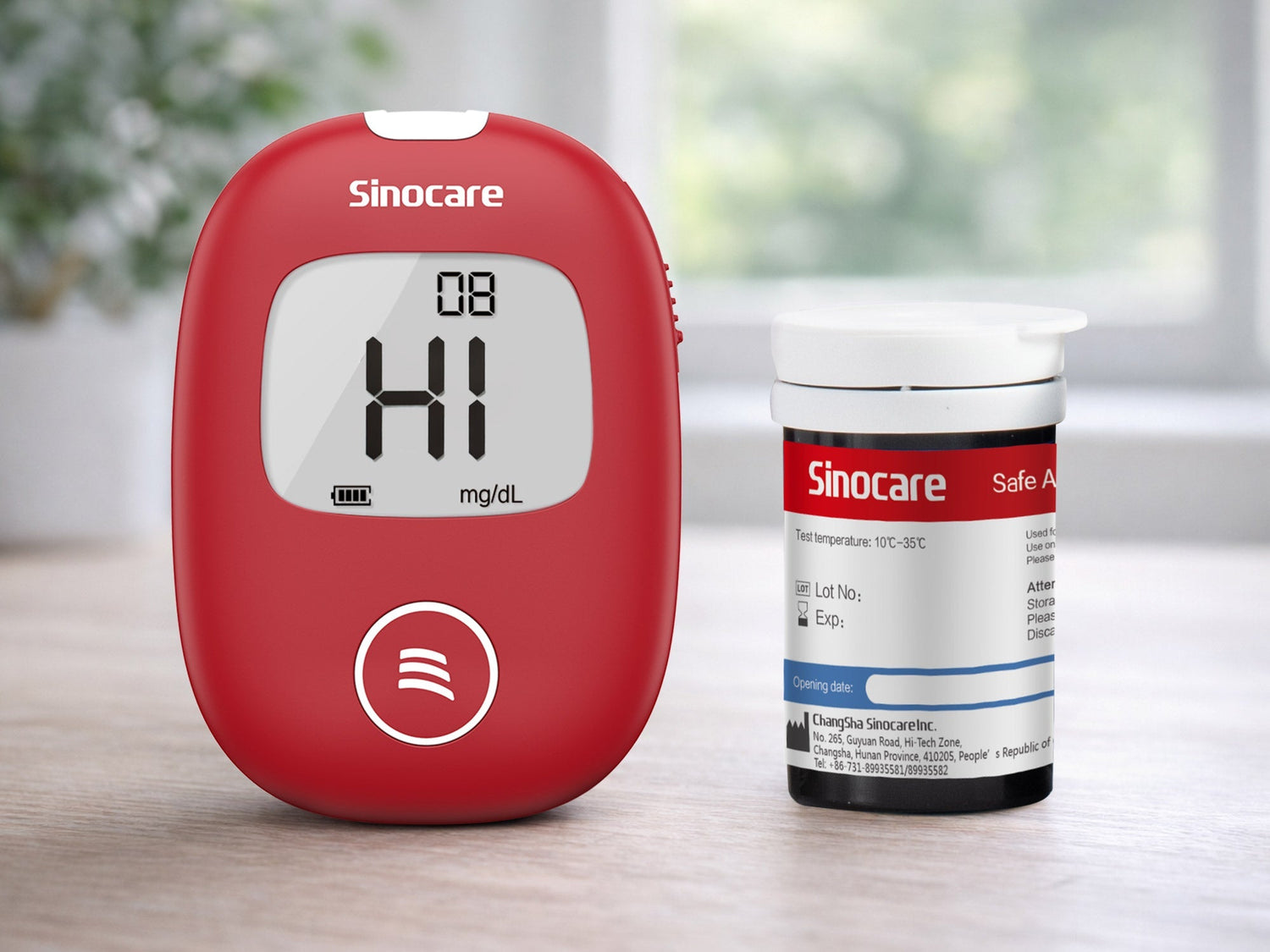
Pode ser uma experiência assustadora e um pouco congelante quando seu glicosímetro de sangue de repente mostra “HI” ou “LO” em vez de um número. O que isso significa? Será que algo está realmente errado comigo? Não importa se você é um paciente recém-diagnosticado com diabetes ou se já usa seu monitor de glicose há anos, ver uma leitura de açúcar no sangue HI ou LO pode ser desconcertante.
Não entre em pânico! Este artigo vai ajudar você a entender o que essas letras realmente significam e o que você deve fazer se as vir.
Decodificando as Leituras “HI” e “LO”
Quando seu medidor diz “HI” ou “LO”, não presuma que seja um sinal de erro. É um alerta, avisando que seu nível de açúcar no sangue está fora da faixa mensurável do glicosímetro. Na maioria dos medidores, essa faixa costuma ser em torno de 20 a 600 mg/dL, ou cerca de 1,1 a 33,3 mmol/L [1].
Essas leituras são essencialmente avisos de perigo. Se seu nível de glicose no sangue estiver acima do limite máximo do dispositivo (cerca de 600 mg/dL ou 33,3 mmol/L em medidores padrão), ele mostrará “HI” para indicar que o valor está perigosamente alto. Isso é comumente interpretado como hiperglicemia severa (nível muito alto de glicose no sangue) que está além do alcance superior do medidor.
Da mesma forma, se seu nível de açúcar no sangue estiver abaixo do limite mais baixo (cerca de 20 mg/dL ou 1,1 mmol/L), ele mostrará “LO”, o que indica hipoglicemia perigosa, ou hipoglicemia severa. Ambas as situações são consideradas emergências médicas e precisam de atenção imediata [1, 2].

Primeiros Passos: Elimine um Erro de Teste
Esta é a primeira coisa que você deve fazer, pois uma leitura falsa de HI ou LO é altamente possível. Você pode ter um erro de teste devido a dedos contaminados ou tiras defeituosas [3]. Então, antes de tratar como uma emergência médica, passe pela lista abaixo para confirmar se a leitura que você viu reflete seu verdadeiro nível de açúcar no sangue:
- Lave e seque suas mãos, depois refaça o teste.
- Use uma tira de teste nova de um novo frasco.
- Insira a tira corretamente e obtenha a amostra de sangue de forma adequada.
- Verifique se a tira de teste tem data de validade.
- Confirme se as tiras foram armazenadas incorretamente (muito quente, frio ou úmido).
- Refaça o teste em outro dedo, se necessário.
- Verifique se o medidor está calibrado e não apresenta problema de bateria fraca.
Se o seu nível de açúcar no sangue continuar mostrando uma leitura “HI” ou “LO” mesmo depois de você verificar a lista acima, é hora de focar nos seus sintomas e tomar a ação apropriada [1].
Plano de Ação: Se Seu Medidor Mostra “LO”
Se você realmente tem uma leitura “LO”, isso significa que você está com hipoglicemia grave (açúcar no sangue extremamente baixo) e sua condição pode se deteriorar rapidamente e se tornar uma ameaça à vida [4]. Aqui está um guia passo a passo do que fazer:
- Não demore, aja imediatamente. Trate como hipoglicemia grave, que pode causar desorientação ou até desmaio. Tome uma ação imediata para elevar seu nível de açúcar no sangue.
- Coma 15 gramas de carboidrato de ação rápida. A regra prática é a regra 15/15: consuma cerca de 15 gramas de açúcar rápido (por exemplo, 3-4 tabletes de glicose, meia xícara de suco ou refrigerante comum, uma colher de sopa de mel ou alguns doces) e depois espere 15 minutos.
- Verifique seu nível de açúcar novamente após 15 minutos. Usando seu medidor (com uma nova tira), teste novamente para ver se seu nível melhorou. Se ainda estiver abaixo de 70 mg/dL (3,9 mmol/L) ou o medidor continuar mostrando “LO”, trate novamente com mais 15 gramas de carboidratos de ação rápida.
-
Saiba quando buscar ajuda médica. Se em algum momento você sentir que pode desmaiar, ter uma convulsão, não conseguir engolir, ou se já tratou duas vezes e seu medidor ainda mostra “LO”, chame os serviços médicos de emergência (EMS) imediatamente (ou peça para alguém ligar para você). Se disponível, uma pessoa treinada deve administrar uma injeção de glucagon ou spray intranasal.
Lembre-se, hipoglicemia grave está associada a uma alta taxa de mortalidade [5]. Leituras repetidas de “LO” significam que seu nível real de açúcar no sangue pode estar criticamente baixo, então não tente “esperar passar”. Ligue imediatamente para o serviço de emergência local [4, 6].
Quando o Medidor Mostra “HI”
Esta mensagem significa que sua hiperglicemia está extremamente alta e você está em risco de complicações graves como cetoacidose diabética (CAD) ou estado hiperglicêmico hiperosmolar (CHE) [7]. Veja o que fazer se aparecer “HI” no seu medidor:
- Avalie seus sintomas. Níveis extremamente altos de açúcar no sangue podem fazer você se sentir muito mal. Você pode apresentar sintomas como náusea ou vômito, sede extrema e boca seca, dor abdominal, visão turva, respiração profunda ou rápida com odor frutado (respiração de Kussmaul) e alteração do estado mental. Todos esses são sinais possíveis de CAD ou CHE. Se estiver sentindo algum desses sintomas, procure ajuda médica urgente [8].
-
Siga seu plano de emergência para diabetes (se você tiver um). Se seu médico lhe deu instruções específicas para lidar com níveis muito altos de açúcar no sangue, como tomar uma dose de correção de insulina ou medicação extra, siga-as imediatamente.
Não pratique atividades físicas intensas nem adie o atendimento. Essas atividades podem piorar a situação nesse estado. -
Não pratique atividades físicas intensas nem adie o atendimento. Essas atividades podem piorar a situação nesse estado.
- Beba bastante água. O alto nível de açúcar no sangue causa desidratação, e a desidratação, por sua vez, pode elevar ainda mais o açúcar no sangue. Comece a beber água (ou líquidos sem açúcar, como caldo claro ou chá) em pequenos goles se sentir náusea. Os líquidos ajudam a diluir o excesso de glicose e eliminá-lo pela urina.
- Continue verificando seu nível de açúcar no sangue e não ignore sintomas adicionais. Faça uma leitura a cada uma ou duas horas, se possível, para ver se está diminuindo. Também fique atento à sua temperatura e ao seu estado geral, pois febre ou infecção podem elevar o açúcar no sangue. Peça ajuda ou chame uma ambulância se necessário.

Dicas para Evitar Picos e Quedas Extremas
É impossível preparar todos para todas as situações, mas você certamente pode reduzir as chances de picos ou quedas severas com algum planejamento e hábitos saudáveis:
- Mantenha um “kit para hipoglicemia” na sua bolsa, mochila ou ao lado da cama. Leve comprimidos de glicose ou uma pequena caixa de suco e tiras e lancetas extras.
- Identifique os frascos de insulina e tiras quando abri-los. Descarte assim que estiverem vencidos.
- Tenha um medidor reserva e baterias extras, especialmente ao viajar.
- Salve os números do seu médico e de um familiar como contatos de emergência
- Eduque familiares e amigos sobre como tratar hipo e hiperglicemia, incluindo o uso de glucagon.
Atualize para um Medidor e Kit de Teste Confiáveis
E o que acontece se seu medidor mostrar HI ou LO, mas acabar sendo uma leitura falsa? Sim, estresse desnecessário! E se você quiser evitar isso, precisa de um monitor de glicose no sangue confiável que venha com tiras de alta qualidade. A Sinocare é uma marca global confiável por mais de 25 milhões de usuários no mundo todo.
Por que escolher os medidores da Sinocare?
- Preciso e confiável. Em um ensaio clínico randomizado de 2020, após avaliar cinco sistemas de automonitoramento da glicose no sangue (SMBG), os pesquisadores descobriram que o medidor Sinocare Gold AQ teve a maior precisão em comparação com outros dispositivos testados.
- Operação simples. A série Safe AQ da Sinocare usa tiras sem código, requer apenas uma pequena amostra de sangue (~0,6 µL) e fornece resultados em cerca de 5 segundos.
- Faixa padrão de medição. Os medidores Safe AQ medem glicose de 1,1 a 33,3 mmol/L (20–600 mg/dL), permitindo a detecção confiável de eventos HI e LO.
- Confiança global. Com mais de 50% dos diabéticos na China usando produtos Sinocare para automonitoramento e uma base de usuários internacionais em rápido crescimento, a marca é reconhecida por oferecer dispositivos confiáveis e acessíveis.
Referências
1. Kongdee R, Parsia B, Thabit H, Harper S. Interpretação da glicose: significado e ação: aprimorando a tomada de decisão no diabetes tipo 1 com descrições textuais. Therapeutic Advances in Endocrinology and Metabolism. 2025 Set;16:20420188251362089.
2. Battelino T, Danne T, Bergenstal RM, Amiel SA, Beck R, Biester T, Bosi E, Buckingham BA, Cefalu WT, Close KL, Cobelli C. Metas clínicas para interpretação de dados de monitoramento contínuo de glicose: recomendações do consenso internacional sobre tempo na faixa. Diabetes care. 2019 Ago 1;42(8):1593-603.
3. Mathew TK, Zubair M, Tadi P. Monitoramento da glicose no sangue. InStatPearls [Internet] 2025 Jan. StatPearls Publishing.
4. Mathew P, Thoppil D. Hipoglicemia. InStatPearls [Internet] 2022 Dez 26. StatPearls Publishing.
5. Yeh HF, Chao WC, Wu CL, Chan MC. Hipoglicemia e mortalidade hospitalar em pacientes criticamente enfermos. Scientific reports. 2025 Jan 21;15(1):2642.
6. Davis HA, Spanakis EK, Cryer PE, Siamashvili M, Davis SN. Hipoglicemia durante o tratamento do diabetes. In Endotext [Internet] 2024 Jul 7. MDText.com, Inc.
7. Mouri M, Badireddy M. Hiperglicemia. InStatPearls [Internet] 2023 Abr 24. StatPearls Publishing.
8. González P, Lozano P, Ros G, Solano F. Hiperglicemia e estresse oxidativo: uma visão integral, atualizada e crítica de suas interconexões metabólicas. International journal of molecular sciences. 2023 Mai 27;24(11):9352.
9. Li X, Zheng S, Pan S, Yan T, Di J, Yang Y, Cheng J. Avaliação da precisão de cinco sistemas de monitoramento de glicose no sangue em pacientes de diferentes departamentos. Experimental and Clinical Endocrinology & Diabetes. 2020 Abr;128(04):210-5.


Deixar comentário
Os comentários precisam ser aprovados antes da publicação.
Este site é protegido por hCaptcha e a Política de privacidade e os Termos de serviço do hCaptcha se aplicam.